

OSR Category 2: What Changed for the 2026-27 Period


Category 2 offshore racing requires a high degree of self-sufficiency. World Sailing defines Category 2 as racing of extended duration along, or not far removed from, shorelines, or in large, unprotected bays and lakes.
The 2026–2027 Offshore Special Regulations were published on 5 December 2025. They are valid through 31 December 2027. Version 2 was published on 5 June 2026 and becomes effective on 1 January 2027.
The OSR are issued by World Sailing. Sail Canada, as the Canadian Member National Authority, also publishes a Canadian extract with its own prescriptions. In that extract, bold blue type marks a Sail Canada prescription. The current Canadian extract is Sail Canada Version 1, dated 6 January 2026, valid from January 2026 to December 2027.
This article focuses on the Category 2 changes that matter most for boat owners, skippers and offshore crews. It does not replace the regulations, Sail Canada prescriptions, or the Notice of Race and Sailing Instructions for a specific event.
Structural integrity comes first
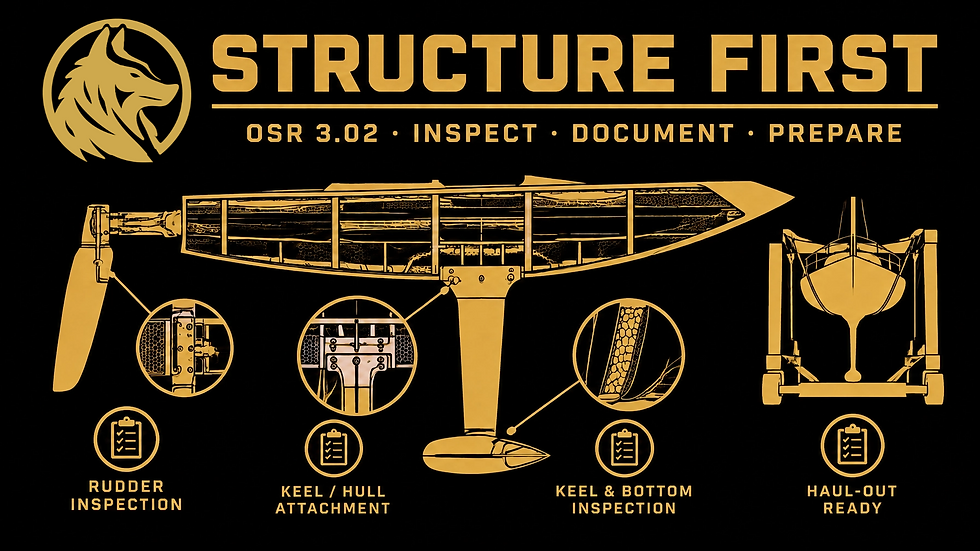
Bottom line up front (BLUF):Non-destructive testing for welded metal keels is the new element, with evidence required from 2030, alongside a revised model inspection procedure.
Under 3.02.2(b), welded metal keels must be examined by an independent qualified person using non-destructive testing such as dye penetrant, ultrasonic testing or X-ray. From 2030, evidence of that testing must be dated within 10 years before the race start, or after a grounding, whichever is later. The revised Appendix L Model Keel and Rudder Inspection Procedure is the reference for how the inspection is done.
OSR 3.02 is also one of the sections World Sailing flagged as changed. After every unintentional grounding OSR 3.02.5 requires an appropriately qualified person to complete an internal and external inspection for Categories 0, 1, 2 and 3.
Baseline context: the boat still needs an out-of-water structural inspection by an independent qualified person, dated within 24 months of the race start, following the owner’s manual for keel-bolt checking and covering visible stress cracks around the keel, hull-to-keel attachment, hull appendages, backing plates, bolting arrangements and keel floors.
Hull construction and stability documentation
BLUF: The new burden falls on older or modified boats: plan review certificates now cover significant repairs and modifications, and the paperwork has to match the boat's current configuration.
The 2026–2027 edition introduces the Hull Construction Standards (previously 'Scantlings) framework, and OSR 3.03.1(d) requires an additional World Sailing certificate of building plan review for all significant repairs or modifications to the hull, deck, coachroof or appendages. That is the item most likely to catch an older race boat that has been refitted or had appendages changed.
The builder must also provide a signed and dated declaration confirming construction in accordance with the reviewed plans. If the builder no longer exists, the organising authority or class rules may accept a signed statement from a naval architect or another person familiar with the requirements.
Baseline construction routes are still recognised: a monohull with a series date after 2009 under 24 m LH must meet ISO 12215 Category A, be maintained to it, and hold a World Sailing building plan review certificate; boats with a series date between 1987 and 2010, and all multihulls, may use the ABS Guide, EC Recreational Craft Directive Category A with a CE mark, or ISO 12215 Category A with signed designer and builder statements.
OSR 3.04 is also flagged as a significant change. For Category 2 monohulls, the accepted stability routes are:
ISO 12217-2 Design Category A.
ISO 12217-2 values of STIX at least 32, AVS of 130 minus 0.002 times boat mass and at least 100 degrees, and minimum righting energy of 172,000 kg metre degrees.
An ORC Stability Index of at least 110.
An IRC Safety and Stability Screening numeral with a base value of at least 28, available only for boats with an earlier series date.
A rating certificate or technical document must reflect the boat’s current configuration. Further reading is available in our stability screening deep dive.
Communications, GNSS, radar and AIS
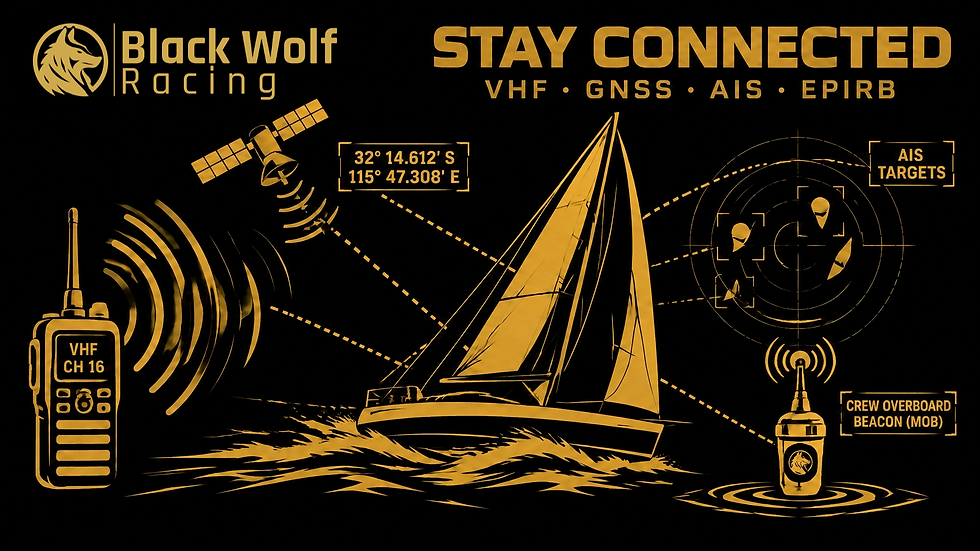
BLUF:The terminology moves from GPS to GNSS, and Category 1 and 2 boats must add an external speaker in the cockpit.
The regulations now refer to GNSS rather than GPS, reflecting GPS, GLONASS, BeiDou and Galileo. Category 1 and 2 boats must also have an external speaker in the cockpit so critical radio traffic reaches the helm without anyone going below.
Baseline communications kit remains: a 25 W installed VHF, DSC-capable if installed after 2015, with a unique MMSI and connection to a GNSS receiver; a masthead antenna at least 38 cm with no more than 40 per cent feeder-cable power loss; an emergency antenna where the main antenna depends on the mast; a handheld VHF of at least 5 W in each grab bag; a second radio receiver capable of receiving weather bulletins; and an AIS transponder using either a low-loss splitter on the masthead VHF antenna or a dedicated antenna at least 38 cm long with its base at least 3 m above the waterline.
Flashlights, EPIRBs and crew overboard equipment
BLUF: New flashlight and searchlight specifications, and EPIRBs registered after 2026 must transmit AIS.
Flashlights and searchlights must be watertight to at least IP67 with at least 400 lumens and spare batteries or rechargeable capability. On a two-person boat, the searchlight must be reachable from the cockpit without going below deck. A 406 MHz EPIRB must include internal GNSS, with AIS transmission required if it is registered after 2026, which makes the registration date the thing to check before the 2027 season.
The EPIRB must be water and manually activated, and registered with the authority for the country code in its 15 Hex ID, with the Cospas-Sarsat International Beacon Registration Database used where direct registration is permitted.
Category 2 also requires an AIS personal crew-overboard beacon for every crewmember, plus GNSS able to record a crew-overboard position within 10 seconds and monitor it, with the monitoring available on deck for two-person crews.
Storm sails and lifejackets
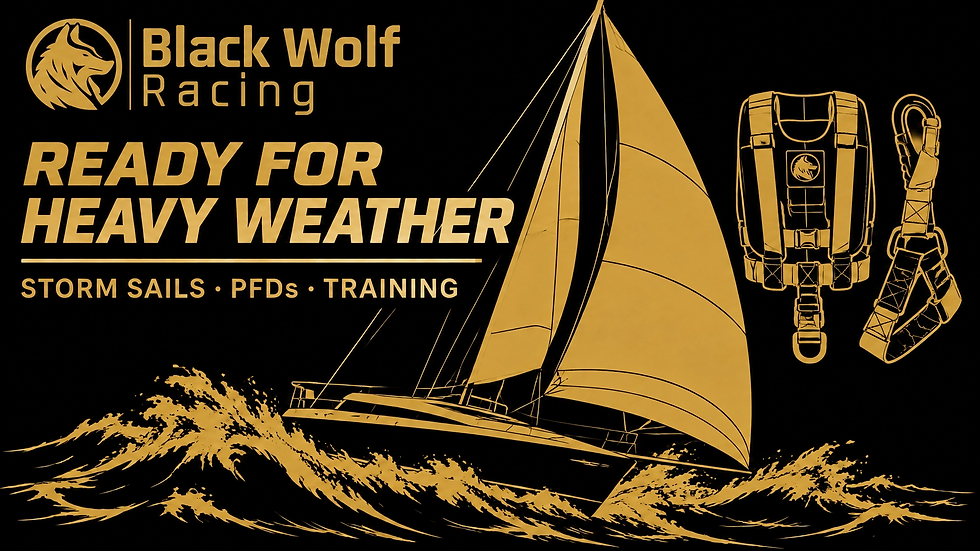
BLUF:The storm jib must fly alone, and every lifejacket must be gas-inflatable, post-2011, correctly sized and inspected.
The significant storm sail change in the 2026–2027 period is OSR 4.27.1, added as an urgent change in November 2025 and effective immediately, which states that a storm jib may not be set in conjunction with any other sail set forward of the forward mast spar.
World Sailing made the change because some yachts were using storm sails as staysails. In World Sailing’s wording, the primary purpose of any storm sail or heavy weather sail is to provide propulsion and steerage in storm and heavy weather conditions, and they must be designed, manufactured and maintained as such.
The change here is OSR 5.01.4, the lifejacket inspection requirement. The person in charge must personally check that every lifejacket has been serviced in accordance with the manufacturer’s recommendation by an approved service station, and that the next service date marked on the lifejacket has not been exceeded.
This is a personal check by the person in charge, not something delegated to the crew. Sail Canada adds Canadian flexibility here, since where the manufacturer permits the owner or user to perform the recommended service, that owner or user is considered an approved service station.
The underlying specification is unchanged: gas-inflatable ISO 12402-3 Level 150 equipment manufactured after 2011, correctly sized for the wearer and marked with the owner’s or boat’s name.
Carry spare cylinders and activation heads for each lifejacket type, plus at least one spare lifejacket.
Read our deep dive on the 2026–2027 OSR lifejacket standard for the detailed PFD and harness discussion.
Practical preparation for Pacific Northwest racing
BLUF:Treat Category 2 as a winter project: assemble the documents, service the safety gear, and hand the Sail Canada extract to the people doing the work.
Start with a documents audit: keel and rudder inspection evidence, construction and plan review certificates, stability documentation, EPIRB registration, liferaft servicing certificates and training certificates.
Make the keel and rudder inspection a winter yard item. If the keel is welded metal, speak with a qualified testing provider now and plan for the 2030 non-destructive-testing requirement.
Budget for an AIS crew-overboard beacon for every crewmember. Check EPIRB registration dates. Confirm lifejacket sizing, service dates, spare cylinders and activation heads. Review the storm sail inventory and practise setting the storm jib independently.
Organising authorities may modify the OSR for local conditions. Canadian boats must satisfy both the World Sailing requirements and any Sail Canada prescriptions, and the Sail Canada extract for Category 2 monohulls is the practical document to hand to a surveyor, rigger or lifejacket service centre. Sail Canada prescriptions, the Notice of Race and Sailing Instructions for the specific event take precedence. Always read those documents before racing.
Our related BC Sailing 2026 Category 3 harmonisation guide provides additional regional context.
Sail Canada prescriptions for Category 2
BLUF: Canadian boats/races must satisfy both the World Sailing OSR and the Sail Canada prescriptions, and the lifejacket rule is the one most likely to catch crews out.
For Canadian Category 2 racing, the Sail Canada extract adds a small number of prescriptions that crews need to catch early.
Lifejackets (OSR 5.01): Sail Canada prescribes a gas inflatable lifejacket manufactured after 2011, with at least 150 N buoyancy, compliant with UL1180 or UL1180C, with manual or automatic gas inflation, ride-up prevention, an emergency position indicating light, a sprayhood, a whistle secured by cord or line, retro-reflective material, and an integrated deck safety harness attachment complying with OSR 5.02. Sail Canada also accepts ISO 12402-3 Level 150, but notes that ISO 12402 is not currently approved by Transport Canada. For Canadian buyers, the UL1180/UL1180C route is the practical route that aligns with Transport Canada approval.
Lifejacket servicing (OSR 5.01.4): If the manufacturer allows the owner or user to perform the recommended service, that owner or user is considered an approved service station. The person in charge still has to confirm the service followed the manufacturer’s recommendation and that the next service date has not been exceeded.
VHF radio (OSR 3.29.5 and 3.29.6): Sail Canada makes the installed VHF mandatory in Canada rather than permissive: at least 25 W rated output, a masthead antenna of at least 38 cm, DSC capability where installed after 2015, a programmed MMSI, and connection to a GNSS receiver.
Liferafts (OSR 4.20.2): Liferafts shall be equipped with an insulated floor. If you are hiring or servicing a raft for a Canadian Category 2 event, check that the pack includes it.
Stability (OSR 3.04.4): For the STIX/AVS and ORC Stability Index routes, if the minimum righting energy is not available, Sail Canada prescribes a minimum sailing weight of 3,000 kg for Categories 0, 1 and 2.
Authoritative sources
World Sailing OSR 2026–2027 Version 2, published 5 June 2026; effective 1 January 2027.
World Sailing announcement: New Offshore Special Regulations for 2026–2027
World Sailing: urgent changes to the design requirement of storm sails (25 November 2025)
Sail Canada OSR 2026–2027 extract for Monohull Category 2, Version 1 (6 January 2026)
The OSR establish minimum safety standards. They do not guarantee safety. The skipper and person in charge remain responsible for deciding whether the boat and crew are ready to start or continue racing.
Disclaimer: The safety information and advice shared in this article are for general guidance and information only. Every skipper and vessel operator is solely and ultimately responsible for the safety of their crew, boat, and decisions made on the water. All skippers must ensure they are fully informed, exercise their own judgment, and comply with all applicable laws, regulations, and race rules. Readers should do their own research and consult with qualified professionals as needed, as situations on the water can vary widely and may require different actions.


Comments