

Stability Screening Deep Dive: What It Is and Why It Matters

If you're planning to race offshore or participate in serious yacht racing events, you've probably encountered the term "stability screening" in race documentation. But what exactly does it mean, and why should you care? Let's dive deep into this critical aspect of sailing safety and racing compliance.
What is Stability and Why Does It Matter?
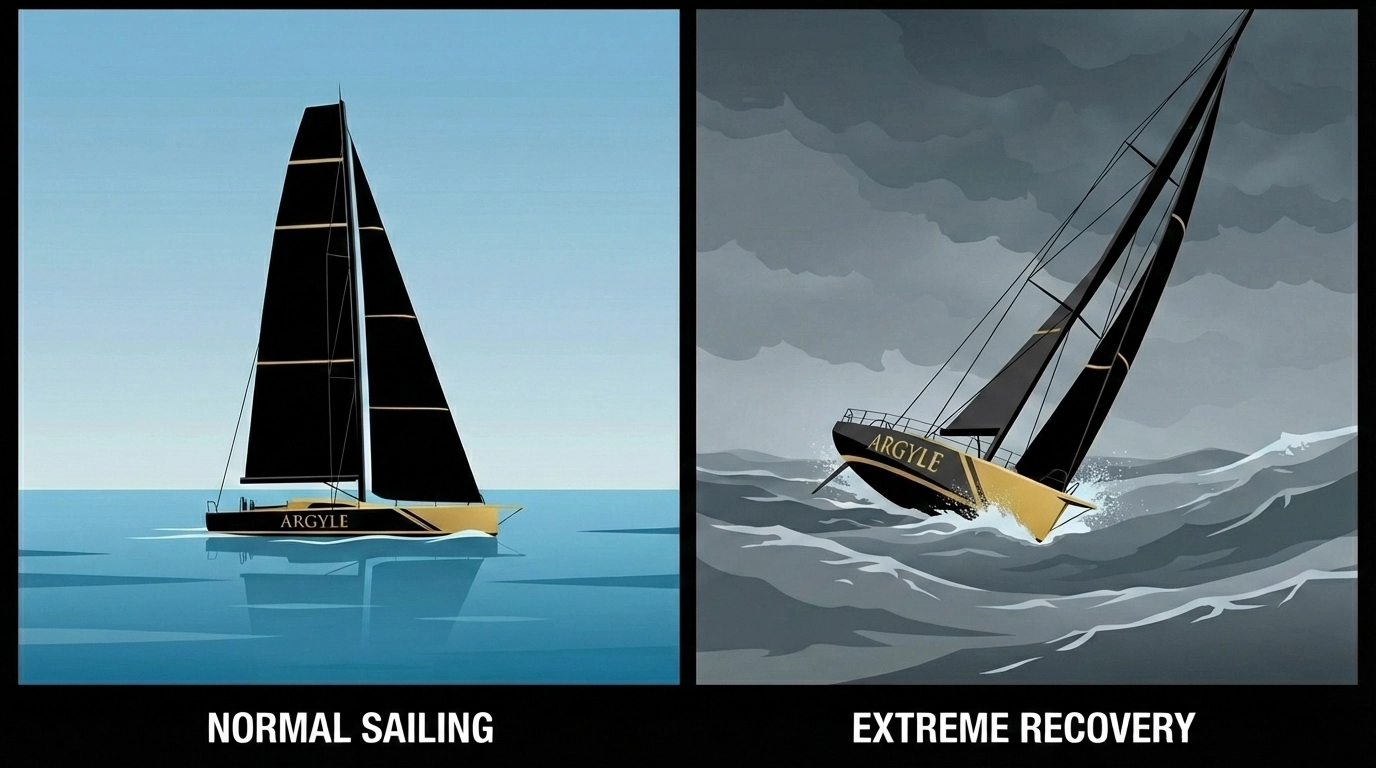
Stability screening verifies that your boat meets defined standards for resisting capsize and for recovery when pressed by wind and waves. It confirms, via documentation, that boats entered in a race meet a minimum righting behaviour for the category of offshore race.
In offshore conditions, stability is safety. Screening ensures performance gains have not compromised safety fundamentals.

Stability screening is required by many offshore events. It provides organisers with objective proof that your yacht can handle rough conditions and gives you clear documentation of capability.
How Do You Know If You Need Stability Screening?
Check the Notice of Race (NoR) and Sailing Instructions (SI) for your event. Requirements vary by race, but most Pacific Northwest distance races align with World Sailing’s Offshore Special Regulations (OSR).

Canadian Racing Requirements
Most BC and Canadian offshore events reference OSR Category 3 for distance racing. Amendments can be prescribed by Sail Canada, BC Sailing, or the organising authority, but changes to stability are uncommon.
Key references (monohull baseline is OSR 3.04). World Sailing updates its document every two years. The current set covers 2026-27:
If the NoR cites “Category 3” and there are no lower-level (Canada, BC, or race) changes to OSR 3.04, the World Sailing stability standard applies.
In 2026, the Patos Island Race Notice of Race (NoR 2.3) and the Southern Straits Event Rules (ER 1.5) both reference OSR Category 3 requirements. If you wish to participate, your boat must comply with all OSR Category 3 standards, including stability. At each level of authority, amendments are possible. Sail Canada, as the National Authority, can prescribe changes to the base OSR and made small clarifications to stability in the 2024-25 rules. BC Sailing has harmonised the most common category of distance racing in the province, and the race’s organising authority can also amend its rules. Typically, this is done sparingly, and the World Sailing document is, for all intents and purposes, unchanged. Safety matters, and the experts at each level don’t want to take unnecessary risks with your life.

The Screen
There is no guarantee your boat will pass the screen. It is designed to ensure boats are appropriate for the potential race conditions, and it gets progressively more demanding as the category increases.
The Requirements of the OSR
This is where it can get technical. The OSR becomes detailed quickly. When reading the OSR, always check the left-hand margin—you may jump from one category to another without noticing. Here is the text for Category 3:
3.04.1 c) Compliant with ISO 12217-2, design category B or higher, or the requirements of OSR 3.04.2, OSR 3.04.3, or OSR 3.04.4.
These are just references to other standards. Let’s break it down:
“Compliant with ISO 12217-2, design category B” -- There’s a footnote stating that if you meet the European standard and have a CE mark or declaration stating Category B, your boat is acceptable for Cat 3 racing. This is often found on a manufacturer’s tally plate and indicates maximum horsepower and number of persons.
“or the requirements of OSR 3.04.2, OSR 3.04.3 or OSR 3.04.4.” -- This refers to the next three tables in the OSR. These are rough equivalents that may be easier to find if your boat wasn’t built in Europe. In the three tables you will find columns for the equivalents that are acceptable for each category of race.
The tables refer to technical numbers and values that may not be clear. For a technical breakdown of those numbers and what they mean, see Sail Canada’s Stability Screening site.

That’s Nice – I Want to Race
Okay, with all that said, we still aren’t any closer to showing that we’re eligible to race. Let’s look at a few ways to demonstrate eligibility to a race organiser, such as the Patos Island Race or the Southern Straits Race. (They’re friendly folks who want you to participate, have a good time, and return with your fingers and toes intact.)
Follow these steps for any boat (new, old, or modified):
Finally, share and document your research. If you run into difficulty, let the organiser know; they want you to race safely and may have more resources. They may also be able to forward your research to Sail Canada and get more boats on the stability screening list, making it easier next time.
Final Reminders
Keep it simple: confirm the rule cited in the NoR, match your boat to an accepted pathway, and submit clear documentation. Support community resources—race offices, BC Sailing networks, and class groups are ready to help.
Disclaimer: The safety information and advice shared in this article are for general guidance and information only. Every skipper and vessel operator is solely and ultimately responsible for the safety of their crew, boat, and decisions made on the water. All skippers must ensure they are fully informed, exercise their own judgment, and comply with all applicable laws, regulations, and race rules. Readers should do their own research and consult with qualified professionals as needed, as situations on the water can vary widely and may require different actions.

Comments