

PHRF BC Scoring Decoded: Time on Distance vs. Time on Time


You cross the finish line third. Your buddy on the slower boat finishes fifth. But when corrected times come out, they beat you by 30 seconds.
What just happened?
Welcome to PHRF BC scoring. If you've ever stared at results wondering why your elapsed time didn't match your corrected time, this one's for you.
What Is PHRF BC Anyway?
PHRF stands for Performance Handicap Racing Fleet. It's the handicapping system that lets a 25-foot boat race fairly against a 45-footer.
Every boat gets a rating: a number that reflects its speed potential. Lower numbers are faster boats. Higher numbers are slower boats.
In BC the group that administers the fleet is a committee of BC Sailing. PHRF BC assigns the ratings, conducts reviews, and hears protests. But the rating is just the starting point. How do race committees use that rating to calculate results? That's where Time on Distance and Time on Time come in.
Time on Distance (ToD): The Old-School Method
Time on Distance is the original PHRF scoring system. It's straightforward math.
Your PHRF rating represents seconds per nautical mile. The race committee multiplies your rating by the course distance, then subtracts that from your finishing time.
The formula: Corrected Time = Elapsed Time - (PHRF Rating × Distance in Nautical Miles)
Let's say you're racing a 6-nautical-mile course. Your boat rates 120. Your competitor rates 135.
You finish in 1 hour, 15 minutes (4,500 seconds). They finish in 1 hour, 18 minutes (4,680 seconds).
Your corrected time: 4,500 - (120 × 6) = 4,500 - 720 = 3,780 seconds
Their corrected time: 4,680 - (135 × 6) = 4,680 - 810 = 3,870 seconds
You win by 90 seconds.
Simple enough, right?

The Problem with ToD
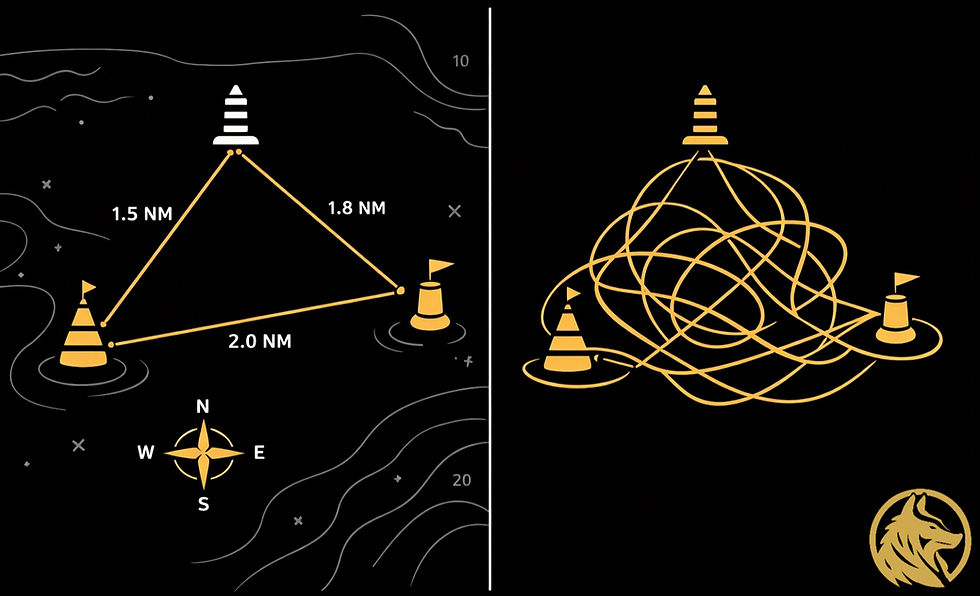
Here's the catch: someone needs to know the exact course distance.
In a race with a fixed course, that's easy. But what about races with custom laid marks? Or courses that shift mid-race due to wind changes?
ToD also assumes the rating advantage is constant across all distances. A boat that's 15 seconds per mile faster over 6 miles should theoretically be 15 seconds per mile faster over 20 miles.
Reality? Not always.
Time on Time (ToT): The Modern Approach
Time on Time converts your PHRF rating into a Time Correction Factor (TCF). You multiply your elapsed time by this factor to get your corrected time.
No distance measurement needed.
PHRF BC certificates issue a base Time-on-Distance rating (seconds per mile). But many local BC regattas score using Time-on-Time, so your ToD number gets converted into a TCF for results.
The official PHRF BC constants (Rule 3.6): A = 650 and B = 520
The official PHRF BC ToT formula (Rule 3.6): TCF = 650 / (520 + PHRF Rating)
Rounding (Rule 3.6): Calculate the TCF to four decimal places, with the fourth place rounded up if the fifth is .00005 or higher.
Then: Corrected Time = Elapsed Time × TCF
Let's use the same boats from before. Boat A rates 120. Boat B rates 135.
Boat A's TCF: 650 / (520 + 120) = 650 / 640 = 1.0156
Boat B's TCF: 650 / (520 + 135) = 650 / 655 = 0.9924
Same elapsed times as before: Boat A finishes in 4,500 seconds. Boat B finishes in 4,680 seconds.
Boat A's corrected time: 4,500 × 1.0156 = 4,570 seconds
Boat B's corrected time: 4,680 × 0.9924 = 4,644 seconds
Boat A wins by 74 seconds.
Wait: Different Results?
You noticed. Same boats, same ratings, same finish times. But ToD gave a 90-second margin. ToT gave a 74-second margin.
This is where things get interesting.
ToT compresses time differences slightly compared to ToD, especially on longer races. The correction is proportional to your elapsed time, not the course length.
That means in light air: where everyone's elapsed times are longer: ToT gives bigger corrections. In heavy air: where elapsed times drop: corrections shrink.
Which System Is Better?
Most PHRF BC fleets use Time on Time today. Here's why:
Practical simplicity. No course distance required. Race committees can score quickly without surveying the entire course.
Proportional fairness. The correction scales with actual race duration. If conditions slow everyone down, the handicap adjusts accordingly.
Better for mixed courses. Pursuit races, distance races, and courses that change mid-event all work seamlessly.
But Time on Distance still shows up, especially in traditional buoy racing with fixed, measured courses.
Some race committees let skippers choose their scoring method before the series starts. Know the difference, and you might pick the one that favors your boat.

Real-World Impact: Light Air vs. Heavy Air
Here's where strategy comes in.
Imagine a 10-mile race in light air. Elapsed times are long: maybe 4 hours. Under ToT, that long elapsed time gets multiplied by your TCF. If you're a slower boat with a higher rating, your correction is significant.
Same course, same boats, but now it's blowing 20 knots. Everyone finishes in 90 minutes. Those same ToT corrections shrink proportionally.
Under ToD, the correction stays constant: your rating times 10 miles, regardless of wind strength.
Fast boats with low ratings sometimes prefer ToT in heavy air. Slower boats with high ratings sometimes prefer ToD in light air.
It's marginal. But in a competitive fleet, marginal matters.
How to Know Which System Your Race Uses
Check the Notice of Race (NOR) or Sailing Instructions (SI). The scoring method should be spelled out clearly.
If it says "PHRF ToT" or mentions Time Correction Factors, you're using Time on Time.
If it says "PHRF ToD" or references seconds per mile, you're using Time on Distance.
Most modern race management software defaults to ToT, but always confirm.
Why This Matters for PNW Sailors
The Pacific Northwest has unique racing conditions. Light air mornings that build to 15 knots by afternoon. Tidal currents that add or subtract a knot of boat speed. Courses that weave through islands and straits.
ToT handles these variables better. It doesn't care if the race committee underestimated the course distance or if you took a different route through the Gulf Islands.
Your corrected time reflects what you actually sailed, not what someone measured on a chart.
For skippers campaigning in PHRF BC events: Van Isle 360, Swiftsure, or your local weeknight series: understanding these scoring systems helps you race smarter.

Common Mistakes
Assuming faster elapsed time always wins. It doesn't. A well-sailed slower boat beats a poorly-sailed faster boat every time in handicap racing.
Ignoring your TCF. Know your number. If your TCF is 0.95 and the boat behind you has a TCF of 1.02, they need to finish 7% faster than you to beat you on corrected time.
Not Inquiring about scoring errors. Race committees are human. If your corrected time looks wrong, check the math. Mistakes happen, especially when someone keys in the wrong PHRF rating.
The Bottom Line
Time on Distance: Straightforward, traditional, requires course distance. Your rating times the miles equals your correction.
Time on Time: Modern, flexible, no distance needed. Your elapsed time times your TCF equals your corrected time.
Both systems work. Most PHRF BC racing uses ToT because it's simpler and handles variable courses better.
But here's what really matters: sail your boat well. The best handicap advantage comes from good crew work, smart tactics, and clean boat handling.
The scoring system just makes sure everyone gets a fair shake.
Now get out there and race. 🐺
Questions about PHRF BC racing or need help preparing for your next campaign? Check out more racing insights on theBlack Wolf Racing blog.

Comments